
Pocket Notebook System
A minimalist approach to staying organized with a pen, paper, and pocket-sized focus

How I got here
I’ve been a relatively serious note-taker for most of my life. I took handwritten notes briefly in college before starting my journey into digital note-taking. Back then, I was relatively platform-agnostic (Windows, Linux, Android, etc.), so I found Evernote to be an incredibly powerful tool to access my notes across all of these platforms.
As the years went by, I migrated to an ever more diverse set of platforms, adding macOS and iOS to the mix. I fell off the Evernote train when they started really limiting what you could do before charging more and more money. I tried many platforms, from as simple as Google Keep to as complex as Obsidian. I couldn’t really make up my mind, but as I got older I wanted to simplify and ended up prioritizing Apple devices as my productivity and personal devices, keeping Windows for gaming, Android for retro handhelds, and Linux for servers. I moved to Apple Notes. I still use Apple Notes for shared notes with my wife and other people who use it, but I’ve primarily moved my “information management” over to Notion. Notion is a powerful tool for many things — in fact, I’m currently writing and editing this post in Notion. But Notion has a key limitation that all digital tools have: I can’t physically flip through it.
So I got some Field Notes (and Field Books?)
I landed on Field Notes as my tool of choice. I started using the off-brand Field Notes called “Field Book” by Elan Publishing on Amazon. They were $1–2 cheaper for a 3‑pack, but after comparing to Field Notes, I determined the cover feels a bit cheaper and the paper isn’t as enjoyable to write on. It’s subjective, and they’re perfectly fine for what they are — I’d even recommend them to someone interested in trying out pocket notebooks. I just enjoy the little bit of charm that Field Notes has with the branding, the use cases, the fun limited-release designs, etc., so I’m willing to pay the very slight premium.
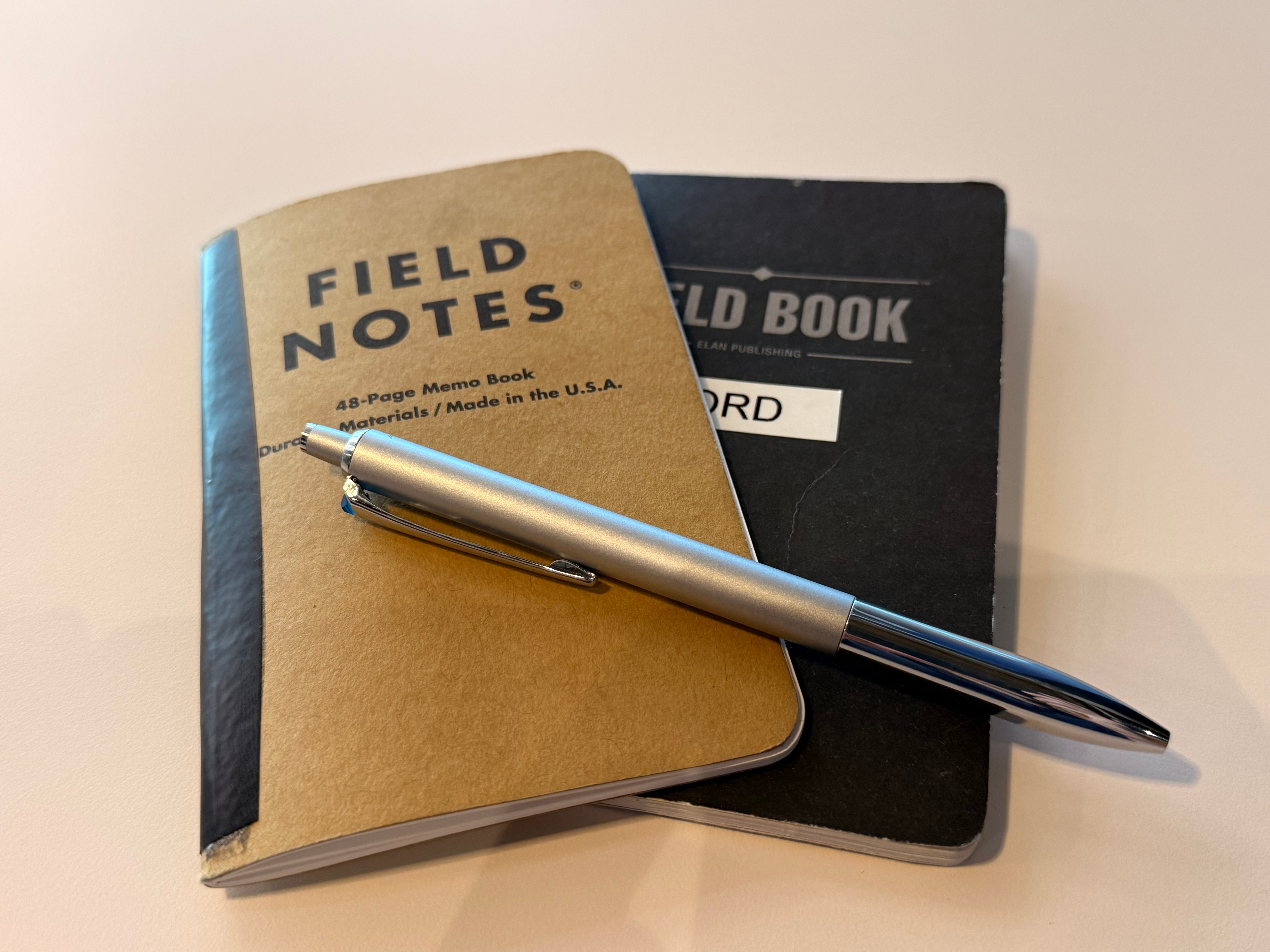
There is one issue that seems to be true across these little 48‑page paper notebooks with three staples holding them together: the staples and spine wear out and can fall apart. I’ve solved this by taking a strip of electrical tape and putting it down the spine to hold it together. I eventually started doing this with all of them right as I got them so they didn’t even have a chance to break down. I’ve since iterated again and switched to hockey tape along the spine, as it has a more naturally complementary feel to the cardstock of the cover compared to the smooth electrical tape I had been using.
Earlier this year I started using a pocket notebook as a replacement for digital notes
I began using a pocket notebook at work to quickly jot down meeting notes, create task lists, store key dates (that I would like to reference outside of my calendar), and record time off for a quick glance. I found that for knowledge management that needed to be searchable, I would continue using Notion, but for my day-to-day information handling, a pocket notebook not only sufficed but excelled. It became second nature immediately and was so easily referenced that I gave up day-to-day digital note-taking within a week of starting.
After a few iterations of how I structured my notes, I basically picked up a hybrid of what Sam Altman mentions in this video:
…and a more traditional note-taking system where I wouldn’t just rip out pages and throw them away.
My work pocket notes structure is as follows:
Start the day with a header that looks like: “10/20 — Monday.”
This can be anywhere on a page. I don’t want to feel like I’m wasting paper if I didn’t finish the previous day at the bottom of a page.
Title of project, list, or meeting
Contents of the note (the majority of the time using bullets)
Line through anything that has been completed or does not need to be referenced again
This is my substitution for ripping out the pages. In case I do need to read it again, it’s there, but the line through it allows me to scan past it when looking for previous notes.
This sounds a little silly, (maybe because it is) but being able to quickly pull out a notebook and flip through it adds a tactile component and removes friction from “rediscovering” things I have written. I found that in my digital notes, I would type them out, file them away, and forget about them forever. In a little notebook that I keep on me at all times, I can write snippets of things that I want to be able to see again and throw it in my pocket. When I have downtime, I’ll pull it out, flip through it, and ingrain what I had written over and over again until it sticks.
After a couple of months of using them for work, I identified a gap in my personal life as well
I had been journaling and, to a lesser extent, tracking my life in an A5 Moleskine‑style book for a while, but due to the larger multi‑page entries, I didn’t find that I was able to adequately refer back to it for things I wanted to quickly stumble upon again. For timely things, I still use my Reminders app with either a time‑sensitive or location‑based trigger, but for lower‑priority notes I decided to try something new. I got a second pocket notebook for my day‑to‑day personal life.
My goal here was multifaceted. I wanted to:
Record day‑to‑day events for quick retrieval. Think, “What day did I make that loaf of bread?” or “What day did we go over to our friend’s house?” Not scheduled events, those are for my shared digital calendar.)
Write down things I learned and ideas that I didn’t want to forget, like: “transhumance: moving of livestock to mountains during warm seasons then back down to farms in the winter” (thank my trip to Andorra for that bit).
Track products and terms I want to explore more deeply but with no specific timeline: “Look into the history of APS‑C sensors in digital and mirrorless cameras.”
Keep lists for doctor’s visits, quick shopping lists, and what I want to accomplish before I leave for work tomorrow, etc.
Get off my phone. 2025 has been the year of de‑phoning and being more intentional with my time. I deleted all social media and am trying to be more mindful of my headspace.
Capture anything I feel like. It’s pen and paper. Draw a squirrel. Play tic‑tac‑toe. There are no rules.
My personal pocket notes structure is as follows:
Start the day with a header that looks like: “10/20 — Monday,” just like work notes. I typically kick this off at my kitchen island in the morning while waiting for coffee to brew.
Put any of the above in any order. The only hard and fast rule I follow is to leave a line between items so I can easily browse through it later and not accidentally blend ideas together.
When I finish a pocket notebook I use a label maker and put start and end date on the cover. I then do one final review of the notebook and move anything I want to continue to revisit to my next notebook with a header, “7/10-8/12” matching the label I put on the previous notebook.
When I’m bored, waiting somewhere, sitting on the couch — whatever — I can pull out my pocket notes and flip through the pages to revisit older ideas, cross off anything I’ve completed, add notes to things that have evolved since I last visited them, or just add to my current day’s entry. I’ve been finding this extremely valuable for forgetting things less. I also noticed that I actually follow through on ideas I had. For instance, this blog started as a “Should I finally make a personal blog?” on “10/14 - Tuesday.”